

Prostaglandin E2 (Compound)
Go to Compound classification| ID | 2321 |
|---|---|
| Name | Prostaglandin E2 |
| Synonyms | Dinoprostone |
| Structure | 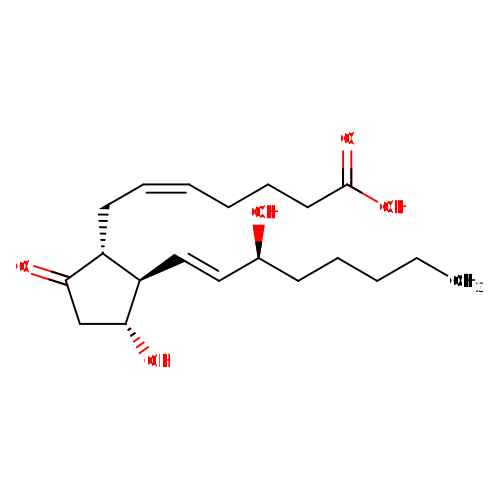 |
| Description | |
| Classification | Compounds > Chemical entities > Organic compounds > Lipids and lipid-like molecules > Fatty Acyls > Eicosanoids > Prostaglandins and related compounds |
| CAS number | 363-24-6 |
| PubChem ID | 5280360 |
| ChEBI ID | 15551 |
| FooDB ID | FDB022498 |
| HMDB ID | HMDB0001220 |
Chemical data
MolDBi data
| IUPAC Name | (5Z)-7-[(1R,2R,3R)-3-hydroxy-2-[(1E,3S)-3-hydroxyoct-1-en-1-yl]-5-oxocyclopentyl]hept-5-enoic acid |
|---|---|
| Traditional IUPAC Name | dinoprostone |
| Formula | C20H32O5 |
| InChI | InChI=1S/C20H32O5/c1-2-3-6-9-15(21)12-13-17-16(18(22)14-19(17)23)10-7-4-5-8-11-20(24)25/h4,7,12-13,15-17,19,21,23H,2-3,5-6,8-11,14H2,1H3,(H,24,25)/b7-4-,13-12+/t15-,16+,17+,19+/m0/s1 |
| InChI Key | XEYBRNLFEZDVAW-ARSRFYASSA-N |
| Molecular weight | 352.4651 |
| Exact mass | 352.224974134 |
| SMILES | CCCCC[C@H](O)\C=C\[C@H]1[C@H](O)CC(=O)[C@@H]1C\C=C/CCCC(O)=O |
ClassyFire Taxonomy
| Description | This compound belongs to the class of organic compounds known as prostaglandins and related compounds. These are unsaturated carboxylic acids consisting of a 20 carbon skeleton that also contains a five member ring, and are based upon the fatty acid arachidonic acid. |
|---|---|
| Kingdom | Organic compounds |
| Super Class | Lipids and lipid-like molecules |
| Class | Fatty Acyls |
| Sub Class | Eicosanoids |
| Direct Parent | Prostaglandins and related compounds |
| Alternative Parents |
Publications with Prostaglandin E2
| ID | Title | First author | Authors | Year | Journal | Volume | Issue | Pages | PubMed ID | DOI | Study design | No. of Biomarkers | No. of Intake values | No. of Concentration values | No. of Reproducibility values | No. of Correlation values | No. of Metabolomic associations | No. of Microbiota associations | No. of Cancer associations |
|---|
Biomarker data
Measurements of Prostaglandin E2 in biospecimens
Concentration values
| ID | Parent ID | Depth | Subject group | Population | Country | Cohort | Biomarker Time definition | Biospecimen | Analytical method | Biomarker | Biomarker detail | Measurement size | Detected (nb) | Detected (%) | Detected only? | Arithmethic mean | Arithmethic SD | Geometric mean | Geometric SD | Min | Min (detected) | Percentile_05 | Percentile_10 | Percentile_25 | Median | Percentile_75 | Percentile_90 | Percentile_95 | Max | Interquartile range | Mean 95% CI lower | Mean 95% CI upper | GMean 95% CI lower | GMean 95% CI upper | Unit | Converted arithmetic mean | Converted geometric mean | Converted median | Converted unit | Adjustment type | Adjusted on | Regressed on | Expressed as | Publication |
|---|
Reproducibility values
| ID | Excretion ID | Subject group | Population | Country | Cohort | Biomarker Time definition | Biospecimen | Analytical method | Biomarker | Biomarker detail | Arithmetic mean | Geometric mean | Median | Unit | Adjusted on | Reproducibility size | ICC | ICC 95% CI lower | ICC 95% CI upper | CV% WS | CV% BS | VAR WS | VAR BS | Publication |
|---|
Associations of Prostaglandin E2 with exposures
Correlation values
| ID | Intake ID | Excretion ID | Subject group | Population | Country | Cohort | Intake Time definition | Intake Assessment method | Intake | Intake detail | Supplement intakes included? | Intake Arithmetic mean | Intake Geometric mean | Intake Median | Intake Unit | Intake Adjusted on | Biomarker Time definition | Biospecimen | Analytical method | Biomarker | Biomarker detail | Biomarker Arithmetic mean | Biomarker Geometric mean | Biomarker Median | Biomarker Unit | Biomarker Adjusted on | Correlation size | Correlation type | Correlation value | Correlation 95% CI lower | Correlation 95% CI upper | Correlation p-value | Significant? | Measurement adjustment | Deattenuated? | Covariates | Publication |
|---|
Metabolomic associations
| ID | Intake ID | Excretion ID | Subject group | Population | Country | Cohort | No. of subjects | Intake Assessment method | Intake | Intervention dose | Biospecimen | Analytical method | Biomarker | Structural identification | Feature selection | Area under curve | Sensitivity | Specificity | PLS-DA VIP | Beta coefficient | Beta coefficient p-value | ANOVA p-value | Publication |
|---|
Microbiota associations
| ID | Biomarker | Experimental evidence | Organism | Biospecimen | Antibiotic | Bacterial source | Substrate | Publication |
|---|
Associations of Prostaglandin E2 with cancer risk
Cancer associations
| ID | Excretion ID | Subject group | Population | Country | Cohort | No. of subjects | No. of cases | No. of controls | Biospecimen | Analytical method | Biomarker | Biomarker detail | Cancer | Study design | Publication |
|---|
Exposure data
Measurements of Prostaglandin E2 exposures in populations
Intake values
| ID | Parent ID | Depth | Subject group | Population | Country | Cohort | Intake Time definition | Intake assessment tool | Intake food coverage | Intake time coverage | Intake Assessment method | Intake | Intake detail | Food description | Supplement intakes included? | Measurement size | Detected (nb) | Detected (%) | Detected only? | Arithmethic mean | Arithmethic SD | Geometric mean | Geometric SD | Min | Min (detected) | Percentile_05 | Percentile_10 | Percentile_25 | Median | Percentile_75 | Percentile_90 | Percentile_95 | Max | Interquartile range | Mean 95% CI lower | Mean 95% CI upper | GMean 95% CI lower | GMean 95% CI upper | Unit | Converted arithmetic mean | Converted geometric mean | Converted median | Converted unit | Adjustment type | Adjusted on | Regressed on | Expressed as | Publication |
|---|
Associations of Prostaglandin E2 exposures with biomarkers
Correlation values
| ID | Intake ID | Excretion ID | Subject group | Population | Country | Cohort | Intake Time definition | Intake Assessment method | Intake | Intake detail | Supplement intakes included? | Intake Arithmetic mean | Intake Geometric mean | Intake Median | Intake Unit | Intake Adjusted on | Biomarker Time definition | Biospecimen | Analytical method | Biomarker | Biomarker detail | Biomarker Arithmetic mean | Biomarker Geometric mean | Biomarker Median | Biomarker Unit | Biomarker Adjusted on | Correlation size | Correlation type | Correlation value | Correlation 95% CI lower | Correlation 95% CI upper | Correlation p-value | Significant? | Measurement adjustment | Deattenuated? | Covariates | Publication |
|---|